Roundtable App — Mission Control for Windows.
Web-based terminal multiplexer and AI agent orchestration platform for Windows. Roundtable mode for democratic agent planning, work mode for hierarchical execution.
- Year
- 2026
- Role
- Solo Engineer
- Domain
- AI/Tooling
What it does
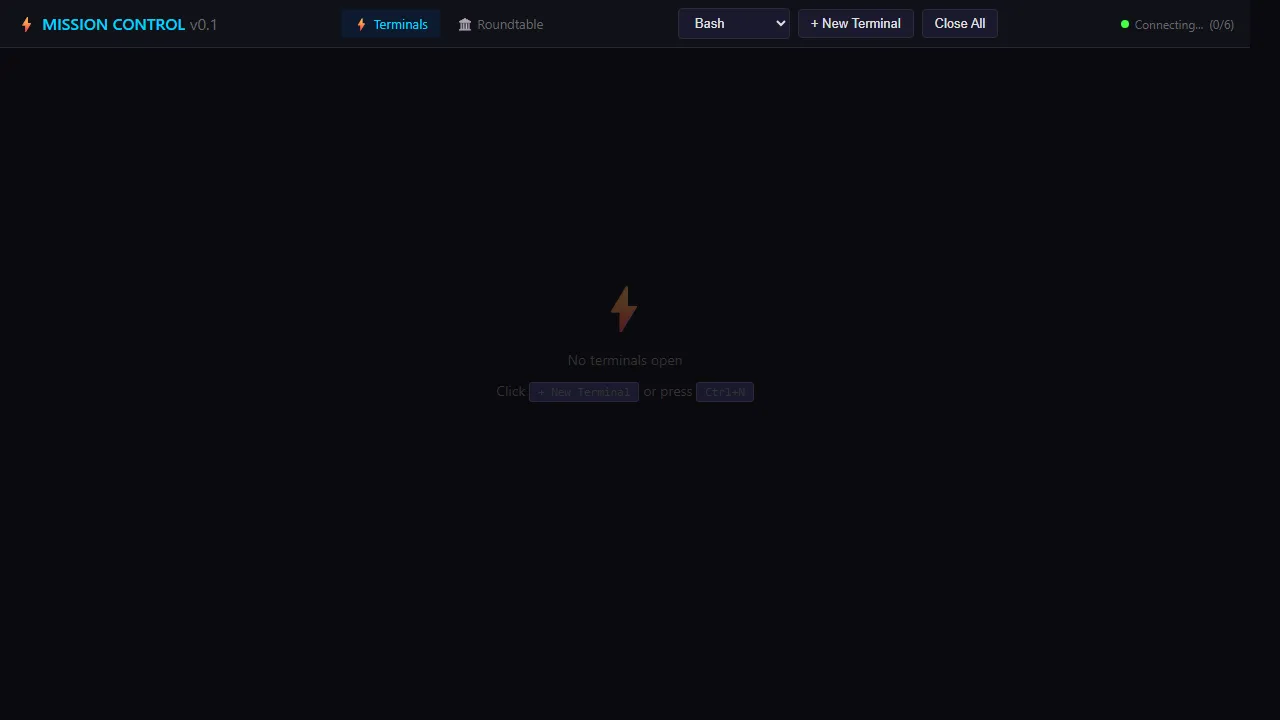
This project is a Windows-native mission control for orchestrating multiple AI agent CLIs in a single interface. The motivation is that tmux is Linux-only and there is no equivalent on Windows that combines terminal multiplexing with AI agent orchestration, collaborative planning and team awareness — so the app fills that gap. The core deliverable is a web UI that hosts up to six terminal panes per session, each running a real Windows CLI (PowerShell, CMD, WSL, Claude Code, Gemini CLI, etc.), plus two operating modes: a Roundtable mode where agents discuss plans democratically with the human as a participating chair, and a Work mode where agents execute under a hierarchy with a CTO/Human escalation path. Source repository is private.
How it’s structured
The backend is built on Node.js with Fastify, terminal sessions are managed through node-pty to handle Windows PTYs cleanly, and a WebSocket layer carries terminal I/O and agent communication in real time. A Roundtable Engine orchestrates the discussion stages — briefing, individual analysis, open discussion, proposal formation, voting and final plan output — and writes the winning proposal into a project plan document at the end of the session. A Telemetry Service captures every action as structured JSON, streamed live via WebSocket so that any agent debugging a failure can query the telemetry to find the exact event it cares about. An Agent Communication Bus carries informal messages between agents alongside a separate event channel for structured updates such as “task complete”, “file changed” or “blocker”, and a context-window watcher monitors each agent’s context-window utilisation so that the system can force a clean handover before the agent runs out of room.
How it works
In Roundtable mode the human posts an objective, the moderator agent presents it to every participant, and the discussion runs through six explicit stages: each agent confirms understanding, posts an individual analysis from its own perspective, joins an open discussion where other agents can challenge and refine, watches the moderator synthesise two or three concrete proposals, votes on those proposals, and finally lets the moderator expand the winning proposal into a full plan.
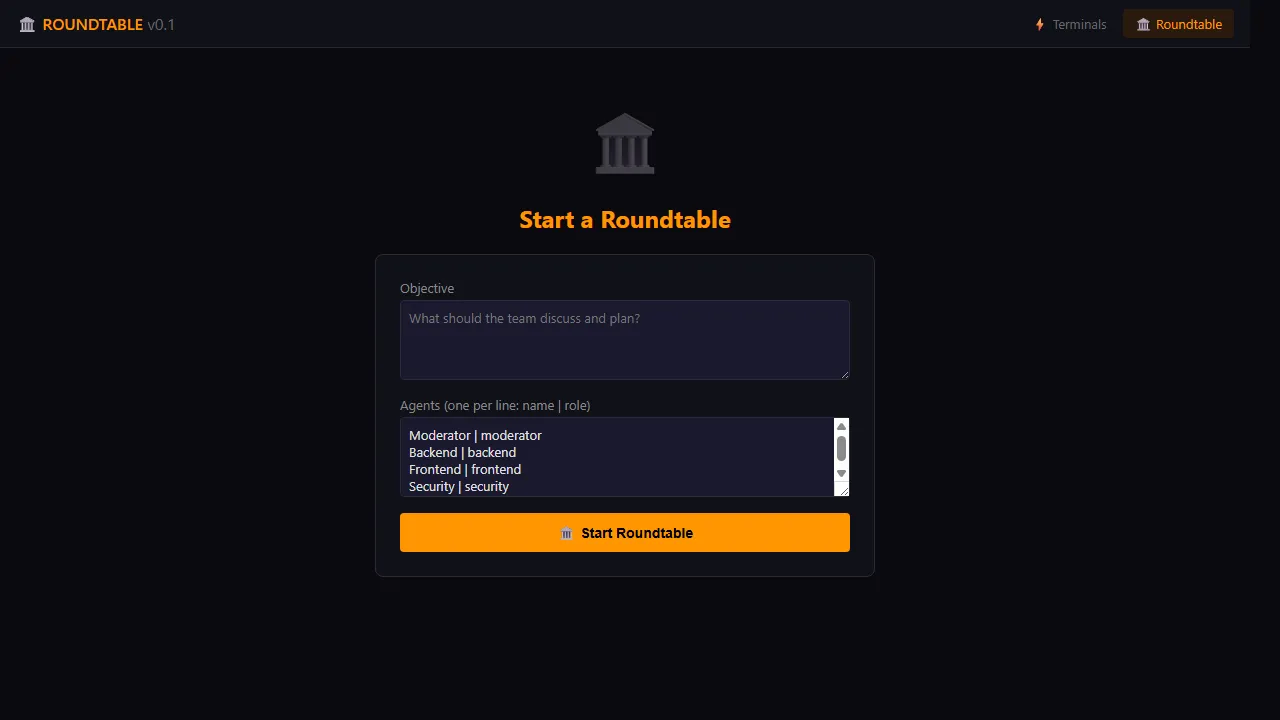
The human can talk to the table at any point through a chat bar that supports targeting a specific agent or broadcasting to all participants. In Work mode (still in design) a hybrid pattern takes over: a shared message bus carries informal agent communication, a structured event system carries the decisions worth recording, and a hierarchy of Worker → CTO → Human handles escalation. The context-window watcher imposes a hard stop at roughly 75–80 % utilisation, forcing the agent to write a complete handover document and request a fresh session before continuing.
What I learned
The biggest insight has been how much agent orchestration depends on having a shared, observable state instead of hoping for emergent coordination. The telemetry stream, the structured event channel, and the explicit stage progression of the Roundtable mode are the things that make multi-agent work auditable rather than mysterious. The voting structure also taught me something I did not expect — turning the moderator into a non-voting chair forces the participating agents to disagree productively rather than defer to whoever frames the question first, and the resulting plans are noticeably better than the ones a single agent produces alone. Building the project on Windows-first APIs (node-pty for PTYs, real PowerShell/CMD/WSL terminals) was the right call because most existing tooling assumes Linux, and a Windows-native mission control is the gap that motivated the project in the first place.